Moss Hunting & Mossy Activities
EXPLORE THE WONDERFUL MINIATURE WORLD OF MOSSES
Click on the image for the onscreen Join our Moss Hunt or click here for the concertina book version.
There is more to mosses than you might think! They are well worth exploring. Ireland is one of the best places on the planet for them and they can be explored anywhere in Ireland at any time of year.
This page has a great collection of free resources designed for 6 to 12 year olds perfect for outdoor adventures whatever the season.
There is a Moss Hunting guide — Join our Moss Hunt — to take outside with you to find mosses and learn about them through outdoor mossy activities and with a bit of science thrown in. Using a mobile phone camera, a magnifying glass, or a hand lens lets you see tiny hidden details.
There are more indoor mossy activities to do back inside after your moss hunt. There is a bit more science, as well as some art based things all linked to mosses and the little creatures that live among them.
You can email in your drawings and we will make a gallery of them. We have provided links to resources for older members of the family too, if they want to find out more about the wonderful world of mosses.
Join our Moss Hunt: this guide to the world of mosses, Ireland’s tiniest plants, has been put together by a botanist – Joanne Denyer, an artist – Shevaun Doherty, and a designer – Jenny Dempsey, and is aimed at 6 to 12 year olds. It gives you a bit of science, then challenges you to find eight mosses, with help on where they grow and what each one looks like. There are fun outdoor mossy activities, including being a rainmaker and measuring cushions.
Don’t forget some mosses are really really tiny, so use the camera on a mobile phone, a magnifying glass or a hand lens to be able to see the details.
Either use the Moss Hunt on your phone or tablet screen or if you have access to a colour printer (or can remote print to your local library or a shop), you can download and print a concertina book version (10 colour single sided pages of A4). Fold and sticky tape the pages together to make a rather special concertina book. When folded it is great to take out with you (A5 size) and when unfolded it’s over two metres long. See the instructions here for the folding and sticking. Or watch the video (here.) It’s easy to make and fun to use. (If you would rather just staple to make an booklet, then download and print the onscreen version above.)
After the Moss Hunt: some indoor mossy activities
You have been on your Moss Hunt and seen some great things. You might like to make a note of your findings, see My Moss Hunt for a neat sheet with suggested things to note. When you have filled in the information, you could fold the sheet in half so it fits in with the concertina Moss Hunt and give it a title and picture on the outside / front.
Here are some fun indoor mossy activities that follow on from your Moss Hunt:
The symbols for acrocarps and pleurocarps are a useful quick way of telling us which type of moss we are looking at. You could develop your own symbols for the habitats / places where you found the mosses: lawn, wall, woodland and rubbish.
You could draw some of the things in the mosses’ names that describe how they look: a cushion, a spear, a feather, a bottle brush, a plait.
The wonderful world of mosses may have been new to you before your Moss Hunt, and the moss world has some new words in it as well. There are eight words in the Moss Hunt guide that were probably new to you. Can you remember any of them and what they mean?
The new words: Acrocarps Pleurocarps Seta Capsule Spores Bryophytes Liverwort Botanist
Here are some of the meanings of the words: Someone who studies plants. A group of plants that are the oldest on the planet. Cousins to the mosses and in the Bryophytes group.
Can you match the words to the meanings? Can you remember the meanings of the other new words and you can check them in the Moss Hunt guide. (Hint: try pages 4, 5 and 6.)
Can you label the four parts of the diagram of the Acrocarps above?
You could draw the weirdest places you looked for moss and put a tick or a cross in a box beside each picture to show whether you did or did not find moss there.
Did you explore a moss covered tree? What did you find on the branch, trunk and base? You could draw a tree – perhaps there is one outside the window that you could look at for your model – and put a big magnifying glass on the trunk, the base and a branch, and make a note of what you found in each place inside the magnifying glasses. There are magnifying glasses in the Moss Hunt guide (see pages 8 or 13).
You could give the mosses you find your own names based on what they look like: bad hair day, mad professor head, star tops, micro tree, waving feather. There is one called Big Shaggy Moss! I kid you not. You could draw exaggerated pictures of them like cartoons.
A bit more art!
Looking at a moss closely enough to be able to draw or paint it, is a great way to really see its detail, and appreciate its shape, pattern, and colour. Colouring in someone else’s drawing is another way to focus on the details. (See here for a useful note about paper for drawing and painting.)
COMING SOON: See here for line drawings of mosses that highlight tiny details and can be coloured in using crayons, felt tips or coloured pencils. Some of the drawings are those used in Join our Moss Hunt. Others are of tiny details that you can only see through a hand lens or microscope. All of them were drawn in the 18th or 19th century. We have given you the line drawings and the coloured in versions of the same drawings. You can follow the natural colours or do your own thing and colour them any way you like.
Imagine how mosses would look to you if you were one of the little creatures. Or if something very strange happened in a dream and you fell through a magnifying glass backwards and were shrunk to the size of an ant. How big the mosses would be. Below is quite a famous picture of many mosses, looking like a jungle, it was painted by Ernst Haeckel.
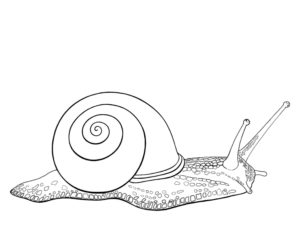
There are two more versions of a line drawing of a snail by Shevaun that you can colour in and add mosses to, perhaps making it look like a jungle. They are under Little Creatures below.
Little Creatures
How about a leg count on those little creatures. How many do they have each? Do you know, or do you need to look at the drawings? Hint: there are always the same number of legs on each side of any creature’s body, so you only need to see and count one side and double the number.
What about the things sticking out of their heads? What are they called? Some are a_______ and some are t________. Which creature has which, and how many of them? Do you know, or do you need to look at the drawings and look up the information?
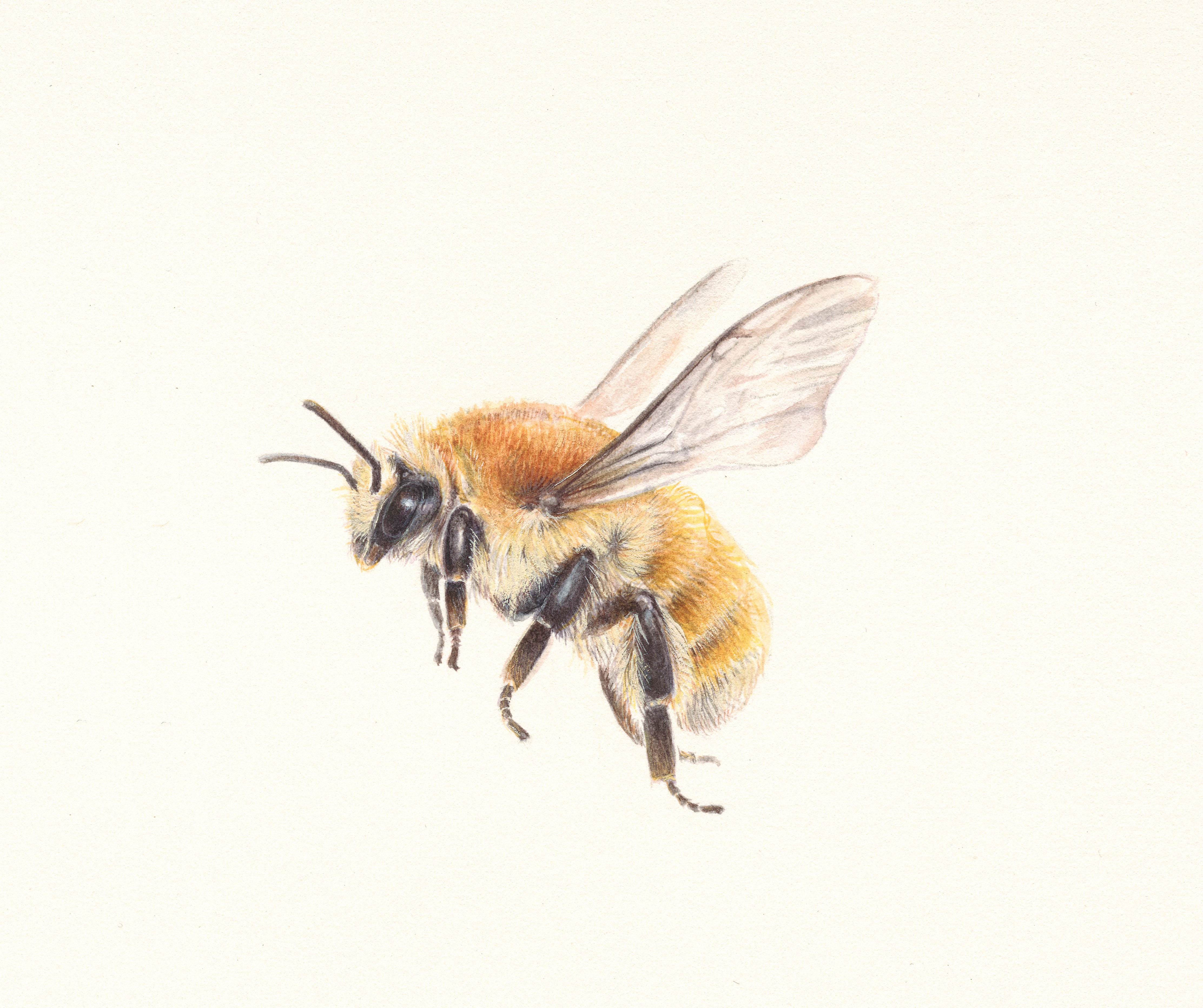
In the Moss Hunt the Moss Carder Bee tells us that she nests on the ground and uses moss to cover her nest. You could draw the other creatures and give each of them a speech bubble with an interesting fact about them. It could be where they live or what they eat.
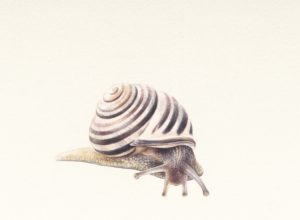
Shevaun draws her creatures and mosses and other plants carefully with all the details exactly as they are in the real world. See here for the specific type of ant, bee, ladybird, snail and the two mosses she drew on the cover of the Moss Hunt.
It’s an interesting process to have to look at something carefully enough to be able to reproduce it exactly and accurately. You could have a go at doing this with colour and pattern and colour in one of the line drawings of snails or the cover picture that Shevaun has given us for you to use.
Or you can choose to use the drawings to create your own designs for snail shells. Here is a large drawing of the snail. Here is a drawing with a smaller snail and room to add mosses all round it, either carefully observed and reproduced or of your designs. Shevaun has named the snail Dawson, after the English botanist to whom Ellen posted rare mosses she found. She has captioned the smaller drawing ‘Dawson the snail needs some mosses’.
Another two bits of science!
Two things – symmetry and spirals.
Do you know what it means if something is symmetrical? Imagine you have a picture of yourself standing up and facing front. If you draw a line down the middle of the picture, between your eyes, down the middle of your nose, etc, etc, there will be the same things on each side – one eye, ear, shoulder, arm, leg, etc. On the outside humans are symmetrical, as are those little creatures with the same number of legs (and wings and other things) on each side.
Snails are a bit different as they have a shell with a spiral shape that is not the same on either side of a central line.
We’d like you to look carefully at the snails in the Moss Hunt and if you can, also look at real snails outside in a garden, hedgerow, park or woodland. First looking in the Moss Hunt, looking at each snail, which side of it is its head? To the right or to the left of its body as you look at the picture? How many pictures of snails are there in the Moss Hunt, and how many have their head to the right, and how many to the left?
Snails are described as right handed or left handed depending which way their shell coils. Did you know that almost all snails are right handed. In fact left handed snails are as rare as one in a million.
So doesn’t that mean there shouldn’t be any in Moss Hunt if Shevaun is so careful to draw things true to life? Well, have you heard of ‘artist’s licence’? This is the idea that an artist has a bit of freedom to change something if they think they can make it look better. Here it was actually ‘designer’s licence’ when Jenny Dempsey, the designer, flipped round the picture of the snail because she preferred the way it looked on the page. We decided to leave it, see if anyone spotted it, and write this piece to go with it!
Drawing and painting mosses
If you are going to draw and paint mosses, find ones where there is plenty of them, and just take tiny bits home with you.
Drawing mosses: use a pencil, either HB or a harder one, H or 2H, and keep it sharpened to a point to get fine lines. You will need a good quality eraser too!
Shape and pattern: look closely, enlarging with a phone camera, to see distinct shapes of leaves. What are the edges of the leaves like? And the tip? How do the leaves attach to the stem, what pattern are they in? Shevaun Doherty, the botanical and nature artist who drew the cover picture on the Moss Hunt and the little creatures, says it’s useful to understand a bit about the parts / anatomy of the plant or creature before you draw it.
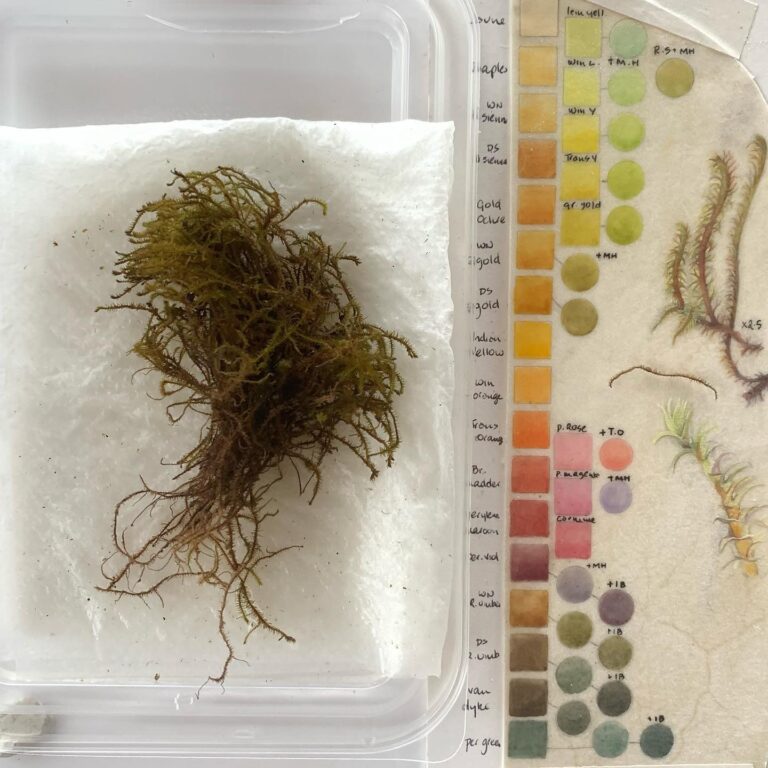
Painting and colour: watercolours are great and a small brush (round, size 4). Watercolour paper will make a difference too. (See here for a useful note about paper.) Look carefully at the colour of mosses. Shevaun Doherty says it’s important to get the right shade of green, and it’s best to mix your own. You need blue, yellow and the tiniest bit of red or pink. You could make yourself a colour chart of the greens you have seen in the mosses.
Next steps: you could start a sketchbook for your drawings, and practice drawing regularly. Little sketches and painting bits of something is great practice.
If you want to make a serious start on botanical art, then consider the lovely Botanical Art Starter Pack here that Shevaun has developed with the Ellen Hutchins Festival team.
Shevaun Doherty is a highly talented botanical and nature artist who has worked on many projects for the Ellen Hutchins Festival. She has drawn seaweed, lichen, a liverwort and a Large Flowered Butterwort for book covers. See here for Shevaun in action, painting a bee on lavender and a rose hip.
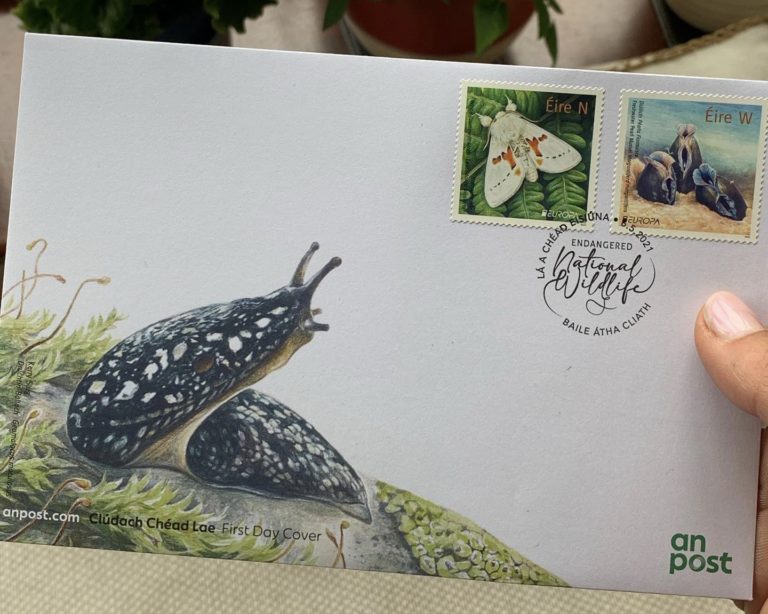
Shevaun has twice been the artist for stamps for An Post, most recently in May 2021 with the series on Endangered National Wildlife. As well as the two stamps, the First Day Cover features Shevaun’s drawing of a Kerry slug.
The design of the stamps and cover was by Jenny Dempsey, designer for all Ellen Hutchins Festival projects, including Join our Moss Hunt. See the An Post site for information about the stamps.
Jenny Dempsey designed the leaflet on Bryophytes of West Cork and the book Mosses and Liverworts: An introductory guide to the Bantry Bay area. She also designed the whole of the Botanist Ellen website which tells Ellen’s story.
Joanne Denyer wrote Join our Moss Hunt. She is one of Ireland’s few bryophyte specialists and the Ellen Hutchins Festival is very pleased to have her on ‘Team Ellen’. Look out for events run by her in the Ellen Hutchins Festival in Heritage Week in August.
The photo above shows Joanne Denyer, author of Join Our Moss Hunt, using a hand lens. They are very clever little things that, when used properly, very close up to your eye, can show you wonderful tiny details of mosses and other natural things such as lichens. We have made a tiny (30 seconds long) film on How to Use a Hand Lens, see here and we sell hand lenses in the online shop, here.
Nature Art and Creative Adventures with Leaves and Paint
See here for more information on nature art and art materials: including a series of wonderful free nature art activities for age ranges 5 to 8 years, 9 to 12 years and 13 +. Creative Adventures with Leaves and Paint by nature artist, Sue van Coppenhagen. These were developed in June 2021 for Cruinniú na nÓg, the national day of youth creativity. Autumn leaves are still on the ground and evergreen leaves are always there. Both are great for many of the Creative Adventures.
Moss Hunters: Ellen and Cousin Tom
Ellen Hutchins went moss hunting with her cousin Tom Taylor. They both became botanists, they both found ‘new’ mosses and had mosses named after them. That was over two hundred years ago, before photography was invented. So they had to draw the mosses and other plants they found if they wanted to show someone else what the moss or plant looked like ‘fresh’ or in the wild.
Ellen and Tom drew plants, but no one drew a picture or portrait of either of them, so we don’t know what they looked like, either as children or as adults. You could draw one or both of them moss hunting.
Or you could draw just one of their hands or fingers, touching a moss, and this would show the scale / size of the moss.
You could look here to see what clothes they probably would have worn as children and adults over two hundred years ago, in the early 1800s, or you can decide what they would like to have worn and draw them in those.
Tom Taylor worked with another botanist, William Hooker, to write a book on mosses. Some of the pictures from the book are used in Moss Hunt. See pages 6, 7, 11 and 12. For more information on Ellen’s story, see here.
Send us your drawings
You can use Contact Us in the bottom bar of the website to send us drawings or notes from your Moss Hunt and mossy activities. When we have a good collection of them, we will make a gallery page here with them.
Going on another moss hunt?
Are you ready to go outside again? On another Moss Hunt? One great thing about moss hunts is that however many you go on, you will still see different things, because there is so much out there to explore. You could take a copy of the sheet to make notes – My Moss Hunt out with you, and a picture of a tree with the three magnifying glasses on it.
You could also jump from Ireland’s smallest plants to its tallest – trees. Here is a Twelve Tree Trail exploring some of the country’s most important native trees. (This is best done when the trees all have their leaves on, so not in the depths of winter.)
More on mosses, Ellen and on left handed snails
Here are some notes for older members of your family. If they want to find out more about mosses, there is an introductory video and information here and another website page Mosses & Liverworts of Bantry Bay about them with more resources.
There is a guide book available from the online shop on this website. Mosses and Liverworts: An introductory guide to the Bantry Bay Area While the book is written for one specific area of Ireland, it provides an excellent introduction to mosses and liverworts found throughout Ireland. Hand lenses are also available from the online shop. here
There is a delightful and thoughtful book about mosses, their natural and cultural history, Gathering Moss by Robin Wall Kimmerer.
Read a bit more of Ellen’s story in relation to mosses and liverworts (Bryophytes) here.
Did you notice that the specimen of Ellen’s shown in the Moss Hunt is held in the Herbarium at the New York Botanical Garden? See here for the story of how it got there, and William Hooker is involved in that, and Tom (Thomas) Taylor is mentioned too.
If you are intrigued by left handed snails, here is an article about a scientist and a leftie snail called Jeremy. That story inspired a children’s book, The Snail with Right Heart, which is wonderful and powerful.
Join our Moss Hunt and the material on this page was made possible through funding from the Creative Ireland County Cork grant scheme, the Environmental Research Institute at UCC and Bantry Credit Union, in 2021.