
Ellen and The Bryophytes
Why are Ellen’s specimens in New York?
A large number of Ellen Hutchins’ specimens of bryophytes, collected in the Bantry Bay area over two hundred years ago, are now held in the Steere Herbarium at the New York Botanical Garden. Their journey to get there, and the botanists who owned and studied them on their way, is a fascinating story. Tracking one specimen, allows us to see the place that Ellen held in the specialist community of leading bryologists.
It all started in Glengarriff
In Ellen’s plant list of over one thousand one hundred plants she found in the Bantry area, she notes that Prickly Featherwort (at Ellen’s time called Jungermannia spinulosa, now Plagiochia spinulosa) was found in ‘mountains and woods at Glengarriff’.

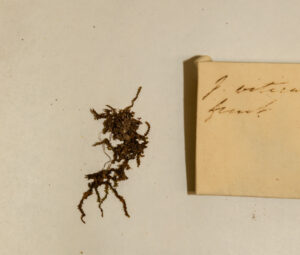
The photo shows the sheet of specimens in paper packets in the Herbarium at New York Botanical Garden. The top envelope (Ellen’s) has written on it: ‘From specimens of this gathering the figure in Hooker’s Jungermanniae was probably drawn.’
Where there’s a Will, there’s a way…
William Jackson Hooker (1785-1865) was knighted for his services to botany and was the first director of the Royal Botanic Gardens, Kew. As a young man he studied liverworts of the British Isles and wrote and illustrated a large book on them called British Jungermanniae, which he worked on for years and published in 1816. Ellen sent numerous specimens of rare and new liverworts to him via Dawson Turner (1775-1858), an English botanist with whom she corresponded from 1807 to 1814.
Dawson Turner acted as mentor to both Ellen Hutchins and William Jackson Hooker. Turner and Hooker were near neighbours in Norfolk. Turner passed Ellen’s liverwort specimens onto Hooker, and he described, drew and published many that she found ‘new to science’, and others where she provided him with a specimen showing a specific feature. This is the case with the Prickly Featherwort.
Despite being fairly common, Hooker says in his British Jungermannia that ‘no part of the fructification [system for producing spores] had been seen in any country, till Miss Hutchins found specimens in Ireland producing calyces in profusion’. Hooker used these specimens for the figure of the plant in his book. (See below). Dawson Turner sent some of Hooker’s drawings to Ellen and she wrote that she thought that they were extremely well done and she delighted in looking at them.

Hooker named one of Ellen’s new discoveries after her, Jungermannia hutchinsiae, and gave it pride of place as the first entry in the book with a lovely dedication to Ellen. He named another of the new liverworts Ellen found after Dawson Turner, Jungermannia turnerii. He thanked Dawson Turner for all the support he has given, and said that he was delighted to be able to link two notable botanists, Dawson Turner and Ellen Hutchins by naming the plant she found after Turner.
Back to the journey to New York, with two more Williams on the way. Dawson Turner posted Ellen’s mosses and lichens to another English botanist, William Borrer (1781-1862) in Sussex.
A near neighbour of William Borrer was a young chemist, William Mitten (1819-1906), who in his spare time was a keen botanist. Borrer encouraged him to study bryophytes and lichens. He gave him a microscope and over time many of his botany books. The Sussex Bryophytes website takes up the story:
Introduced to bryology by William Borrer in Henfield, a village only five miles to the west of his home in Hurstpierpoint, William Mitten started work on a moss flora of Sussex, the first parts of which were published in 1851, but the work was never completed. His expertise soon brought him to the attention of William Jackson Hooker (now Director of Kew) and thereafter bryophyte specimens from all over the world, via Kew, were turning up in packages in Hurstpierpoint, where Mitten steadily worked through them, describing and naming a huge number of plants for the first time.
Ellen’s bryophyte specimens may have been passed to William Mitten by either William Borrer or William Jackson Hooker. A case of where there’s two or three Wills there is more than one way.
William Mitten amassed an enormous collection of fifty thousand specimens of bryophytes. Ten days after his death in 1906, the collection was bought by the New York Botanical Garden. Ellen’s specimens travelled there with all the others.

Returning to our specimen sheet, here it is with Ellen’s envelope open. All the specimens on the sheet are from Ireland. One envelope says Killarney, another is from Isaac Carroll of UCC, Cork.
Cousin Tom
The NYBG biography of William Mitten (1819-1906) describes him as ‘the premier bryologist of the second half of the nineteenth century.’ It also says he was ‘successor to Thomas Taylor, the premier bryologist of the first half of the nineteenth century’. Thomas Taylor (1786-1848) was Ellen’s third cousin, a friend, and a fellow botanist, specialising in bryophytes and lichens. Thomas Taylor and William Jackson Hooker co-wrote a book, published in 1818, Mosses of Great Britain and Ireland, and Thomas Taylor contributed to James Townsend Mackay’s Flora Hibernica of 1836. Thomas Taylor was a doctor and he died in 1848 of famine fever, tending to the sick in the workhouse in Kenmare, Ireland.
Delighting in discovery
Ellen delighted in going ‘among the mountains’ and hunting for new and rare plants. She was passionate about plants, about understanding them better, in particular in the difficult branches of botany including bryophytes. She also had a great appreciation of beauty and in her letters to fellow botanists, Dawson Turner and James Mackay, she enthuses about ‘elegant’ plants, ‘exquisite little beauties’ and ‘my treasures’.
Much of her time was taken up caring for her elderly and ill mother and a disabled brother. Ellen was often ill herself, and had long periods of being unable to go to the mountains. She corresponded for years with botanist Dawson Turner, and, although they never met, they developed a very strong friendship. In a letter in April 1813, Ellen explained and complained about her own illness, family troubles, and her mother’s illness, then wrote:
I have troubled you too much with melancholy details. Let me turn to more pleasing subjects, let me tell you how when I sat to rest my weary frame on a bank of moss I started up with pleasure at sight of J. viticulosa (Saccogyna viticulosa) full of fructification & said to myself how glad Mr T will be. I never felt more pleased at finding it, so very interesting too & connecting it so very nearly with J. trichomanis (Calypogeia azurea), the calyx is immersed in the earth in the same way in that species. It is with us a very common plant.
The liverwort Ellen found was Straggling Pouchwort, known to Ellen as Jungermannia viticulosa now Saccogyna viticulosa. In a letter in August that year, she wrote that she had another specimen to send for Mr Hooker ‘full of fructification in a perfect state. Was he not glad to get that of J. viticulosa.’
-
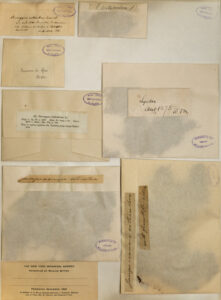
- Specimen sheet in Steere Herbarium, NYBG
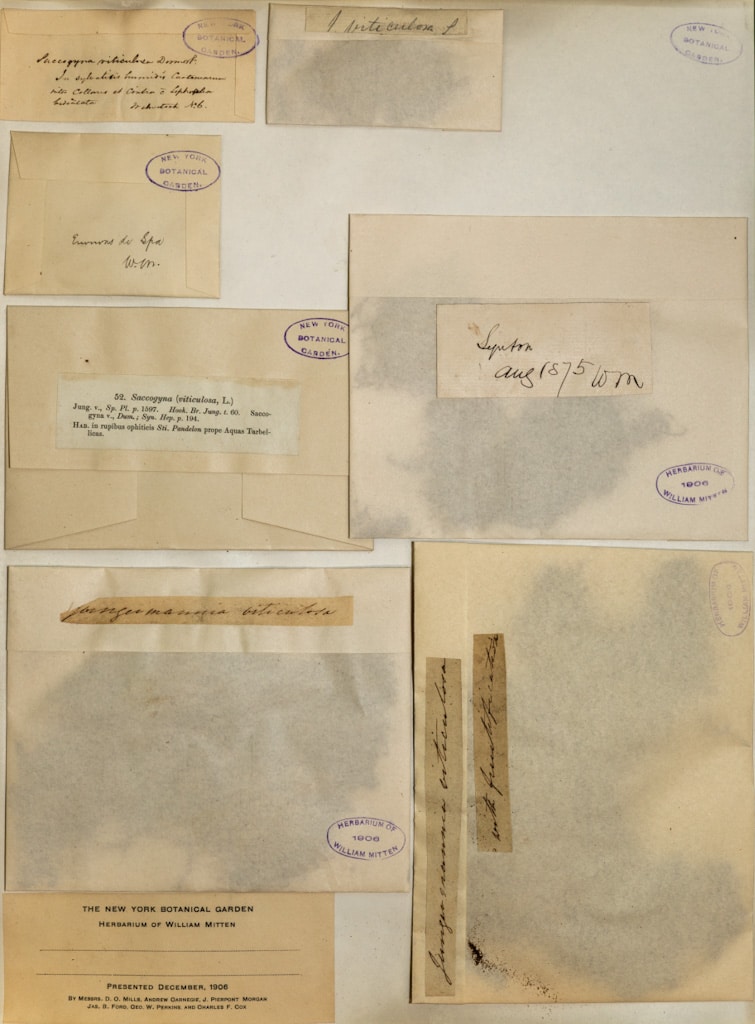
-
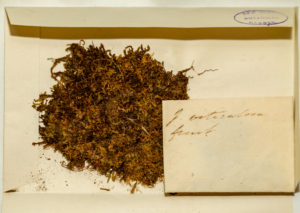
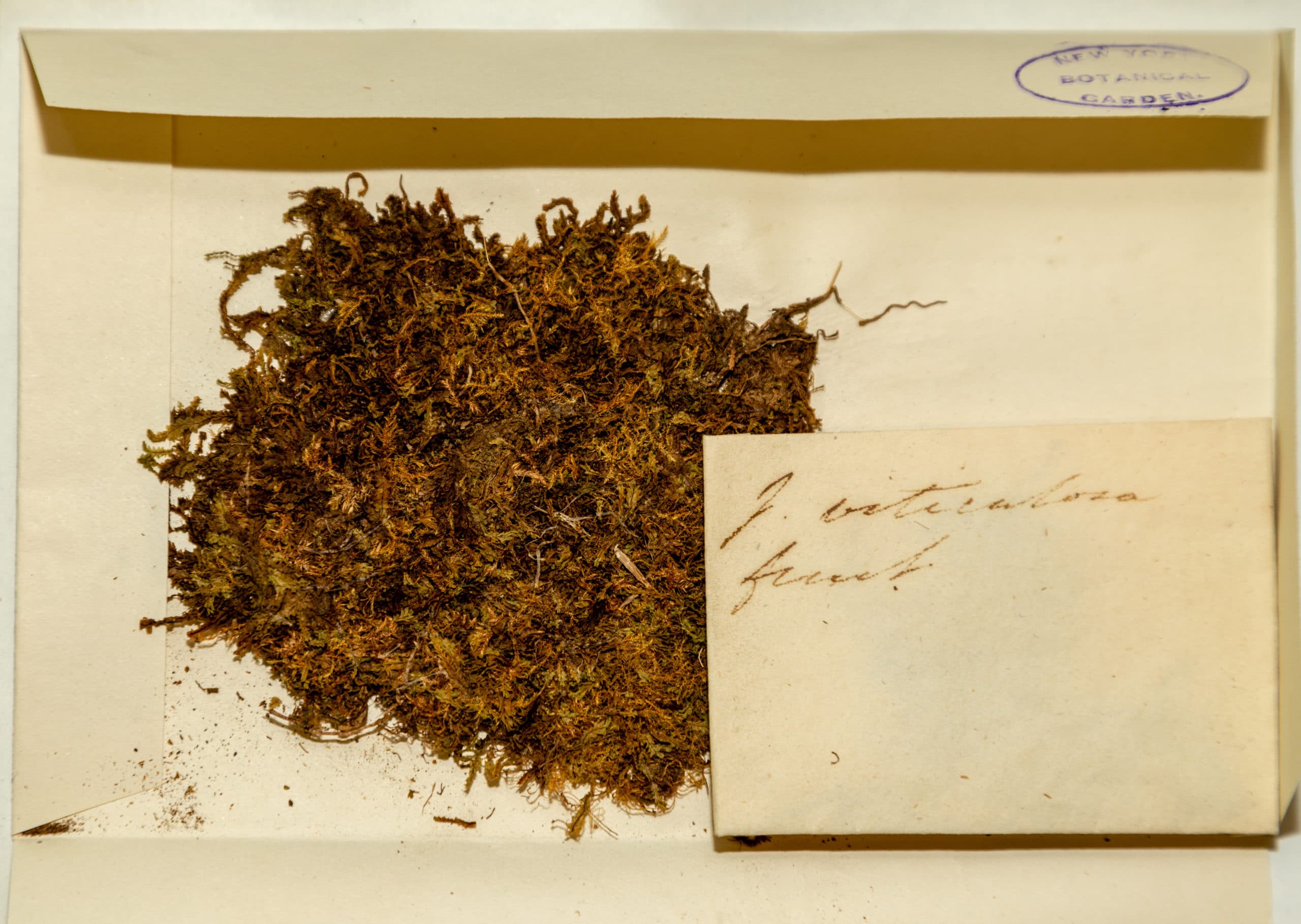
- Large envelope open
-
- Contents of small envelope

Liverworts (Jungermanniae) feature strongly in Ellen’s letters to Dawson Turner in 1812 and 1813. August 1813 was almost the end point for Ellen with her ‘botanising’ as her mother because seriously ill and shortly afterwards so did Ellen, not recovering enough to do anything in botany from Autumn 1813 until her death in February 1815, just before her thirtieth birthday.
What if?
What if Ellen had recovered from her illness and had lived? She might have agreed to Dawson Turner’s request to co-author a major new book on lichens with him. She might have collaborated with William Jackson Hooker and Thomas Taylor on the mosses. She might have been able to go to Dublin to the Botanic Gardens of Trinity College then at Ballsbridge, or the Botanic Gardens at Glasnevin (founded by the Dublin Society in 1795). She might have travelled to England to meet botanists to whom her specimens were sent. She might have visited the Royal Botanic Gardens, Kew (It was open to botanists before its adoption as a national botanic garden in 1840 with William Jackson Hooker as its director.) However, she would have to have been 106 to visit the New York Botanical Garden which was founded in 1891.
Madeline Hutchins. Researcher on Ellen and her great-great-grand niece. 2020
Images on this page courtesy of the Steere Herbarium of the New York Botanical Garden (http://sweetgum.nybg.org/science/vh/)