
‘Esteem & regard’
On this day, 12th July, 215 years ago, in 1810, Dawson Turner wrote to Ellen Hutchins.
Read the full letter from 12th July 1810 HERE.
A missing letter
There appears to be a letter from Ellen Hutchins to Dawson Turner that is missing, in which I assume that Ellen had written about the poor health of her mother, her need to be at home with her and her inability to pursue her ‘botanising’. The last letters that we have from Ellen to Dawson Turner are on 7th and 18th April 1810. The online catalogue for the Dawson Turner correspondence at the Wren Library, Trinity College Cambridge lists a letter on 4th July 1810, and there is a letter in the volume of correspondence for 1810 under that date, but in fact the date of the letter is 4th July 1809 – confirmed by the date written on it, the postmark and the contents.
It is unusual to find gaps in the letters held by Dawson Turner as he seems to have been very organised in keeping and listing them. However, it appears that here he received a letter from Ellen that has not survived.
Moving to friendship
The correspondence between Ellen and Dawson Turner began in April / June 1807, so this is just over three years later. The way in which Dawson Turner expresses his desire for friendship with Ellen is very moving.
Mr and Mrs Borrer
William Borrer (1781-1862) is often referred to as the ‘Father of British Lichenology.’ In 1810 he married Elizabeth Hall, daughter of one of the partners of Brighton Union Bank. They had a new house built for them, Barrow Hill House, in Henfield, Sussex. There is a short biographical note on him and access to a longer piece on the Henfield Museum’s website HERE.
Mr Brown
Robert Brown (1773-1858) has a short biography on the Linnean Society’s website, which begins with “Robert Brown was a leading botanist in his era, very well respected for his excellence in science, and the naturalist on board the HMS Navigator on the historic Flinders voyage to Australia (New Holland) in 1801. The expedition collected over 4,000 botanical specimens, of which Brown classified 2,040 (published in his work Prodromus florae Novae Hollandiae in 1810). See the whole biography HERE. A longer and very interesting piece is on Kids Encyclopaedia Facts HERE.
‘From Sir Tomas Gage a large box of Killarney Lichens’
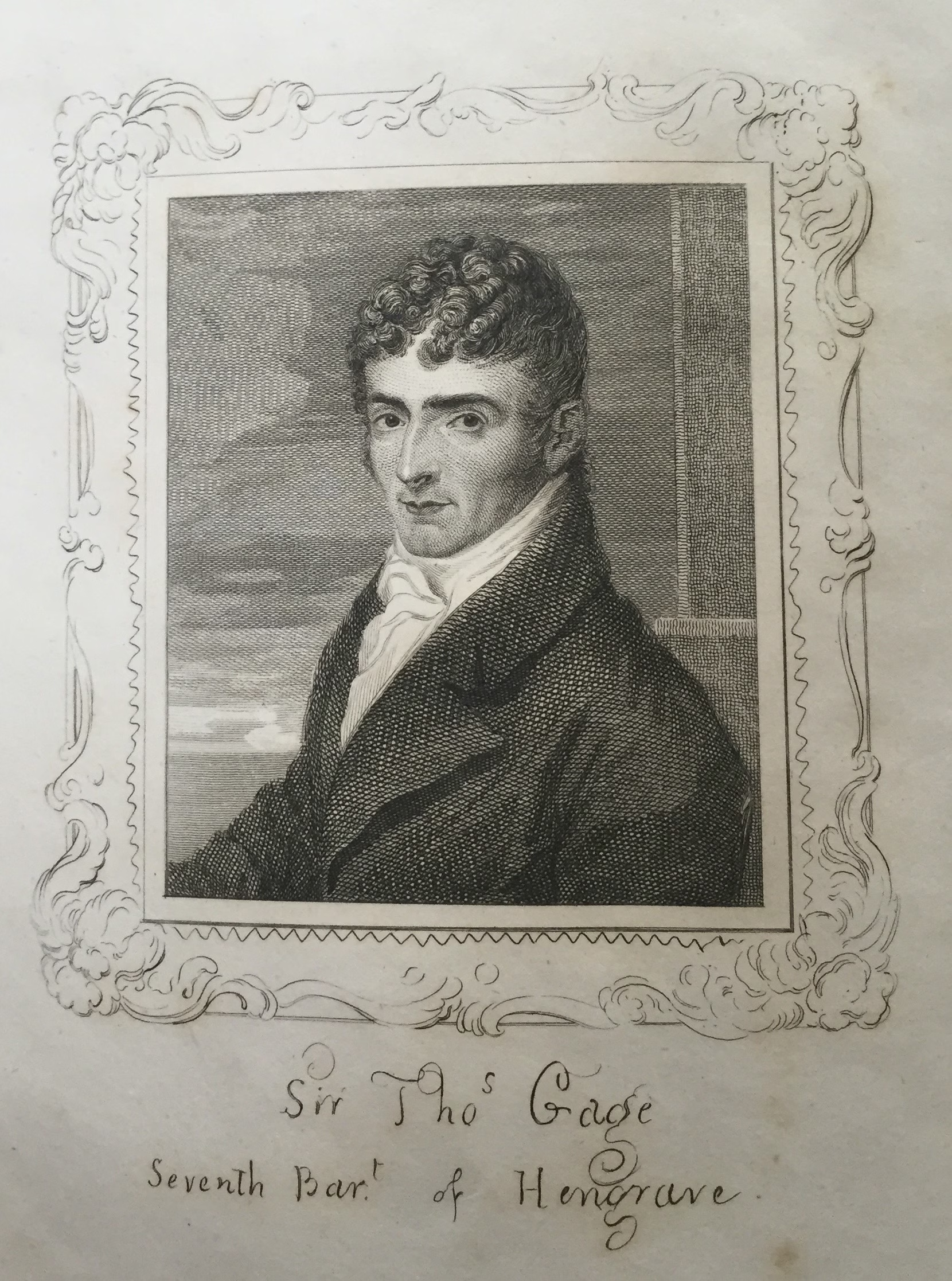
The portrait of Sir Thomas Gage shown above is bound in among the letters in the 1811 volume of Dawson Turner’s correspondence. As well as hoping to be counted as one of Ellen’s friends, Dawson Turner seemed to want to introduce Ellen to others of his botanical circle. Of William Borrer, he wrote ‘I wish I may one day have an opportunity of introducing him to you.’ In his last letter he had written ‘You are likely, I understand, soon to see a botanical friend of mine, Sir Thomas Gage’.
‘Mr Hooker is going to Ceylon’
In his last letter, Dawson Turner had not mentioned Ceylon, He had thought that ‘if Mr Hooker should be disappointed in returning to Iceland’, he and Mr Hooker might travel to Ireland to meet with Ellen.
‘Send double or 3ble letters without hesitation by post’
Postage was paid by the person receiving the letter (not as now the person sending it). The cost was based on distance and the number of sheets, with two sheets costing twice as much as one, three sheets three times as much. Dawson Turner was rich enough to say ‘expense is no object to me’. He may also have found it difficult to read Ellen’s letters when she over wrote or cross hatched them – turning the paper sideways and writing over the first full page of text.
Read the full letter from 12th July 1810 HERE.
The next letter in the 1810 correspondence is from Ellen to Dawson Turner on 24th July 1810 and there will be a blog post on it here on 24th July 2025.
Madeline Hutchins
Researcher on Ellen and her great-great-grandniece.
12th July 2025