Wonderful Plants

Ireland's first Female Botanist

Wonderful Plants

found around Bantry Bay

Seaweeds

SEAWEEDS are marine algae (said ‘al-gee’). They are incredibly important to the planet yet we still know surprisingly little about them.
Algae are still not well understood, even now, two hundred years on from the work Ellen and her botanist friends were doing. New algae are still being found, with no name, and botanists complain that in some cases there are no good books for identifying species. The work that Ellen was doing to understand them better continues today and is not finished yet.

Lichens

LICHENS are nature’s extreme survivors, and grow in the coldest parts of Antarctica to the driest deserts, to the wettest rainforests, to the highest mountains. While they can grow anywhere, if you see lots of them growing, this means that the air is clean and good to breathe. Lichens react to changes in air quality and are useful in showing us pollution levels.

Mosses

MOSSES (with liverworts and hornworts) are the oldest land plants on earth. Bog moss (sphagnum) is particularly interesting because it forms peat bogs, where special plants grow. On some bogs, turf is cut for fuel or the peat is used for garden compost. Other bogs are protected for wildlife. In the past sphagnum was used for nappies and surgical dressings because of its absorbent and antiseptic properties.

Carnivorous Plants

CARNIVOROUS PLANTS are a bit of a surprise. They are flesh-eating plants. The Bantry Bay area has a wonderful collection of plants including some flesh-eating ones – the sundew and butterwort. Both these plants trap insects on their leaves, which are sticky. The sundew then uses its red stalks to push the flies into the middle where they drown in liquid and their bodies are made into fly soup that the plant digests. The butterwort uses its leaves to trap and digest midges and mosquitoes.

Dwarf Willow

DWARF WILLOW is the world’s smallest tree. It is only 1cm – 6cm high. Ellen found it growing on the summit of Knockboy Mountain which is 706 metres high. In 2015, two hundred years after Ellen died, a walk was organised up Knockboy to celebrate Ellen’s life and her botany. The group stopped to eat their packed lunches at the summit, and there was the dwarf willow, in exactly the same spot.

The senior botanist leading the walk had been sitting on it while eating his lunch!

Hutchinsiae

HUTCHINSIAE (said hutch-ins-ee-eye): the four plants here, found by Ellen in the Bantry Bay area, were ‘new to science’ and are named after her. The second part of their botanical names is therefore hutchinsiae.

1a. Liverwort: Herbertus hutchinsiae with Polytrichum Commune (Stars) photo: Robert Thompson 

1b. Liverwort: Herbertus hutchinsiae – photo: Rory Hodd

2. Moss: Hutchins’ Pincushion (Ulota hutchinsiae) – photo: Rory Hodd

3. Lichen: Enterographa hutchinsiae – photo Credit: Jenny Seawright. www.irishlichens.ie

4. Liverwort: Hutchins’ Hollywort (Jubula hutchinsiae) photo: Robert Thompson

MORE ON HUTCHINSIAE: Ellen sent the plants to specialist botanists to describe and publish them. They chose to name these plants after Ellen, in recognition of the value of her part in helping us understand the non-flowering plants. Having a plant named after you is seen as a very great honour in the science world.

Look closely

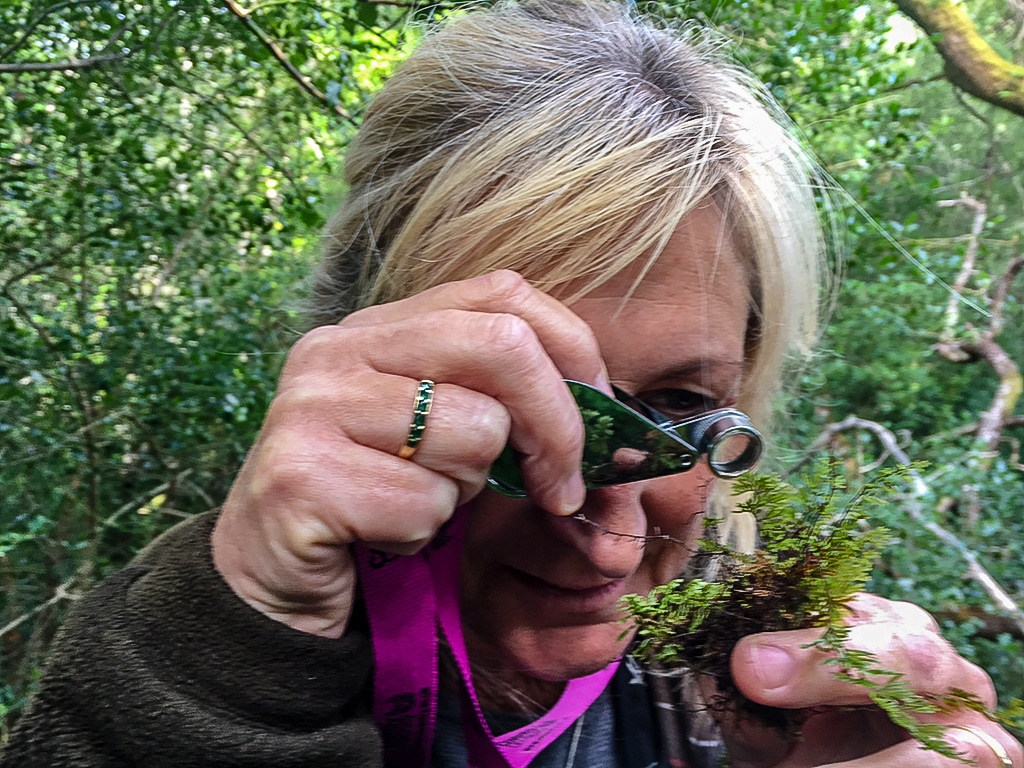
Look closely at a small plant and you will see things that are easy to miss with a quick glance. If you use a magnifying glass, a lens, or a microscope, then you can see much much more. Sometimes the plant looks completely different when magnified. The magnified images show details of the plant that help to understand how it grows. They can also be very beautiful.

Ellen wrote in one of her letters that she had spent five days looking at one seaweed under her microscope. “so wonderful a plant… I spent 5 days admiring it”.
using a hand lens
Using a hand lens

Key to abbreviations used in photo captions

HFC  – Hutchins Family Collection   KEW – Royal Botanic Gardens, Kew, London   NHM – Natural History Museum London   TCC  – Trinity College Cambridge   TCD –  Trinity College Dublin